Between Absolutes
I have been trying to understand the balance between two opposing worlds. One end of the spectrum has been criticized as humble to the point of self- deprecation. The other, extreme self-indulgence. As I find myself swinging like a pendulum from one side to another, there is an attempt to understand and grasp the grey.
A concrete floor is made to create a perfect smooth surface to walk on. Yet it lays directly on top of the natural moving earth. Through time, cracks form. Capturing these cracks are meditative moments where I explore the beauty in the imperfections.

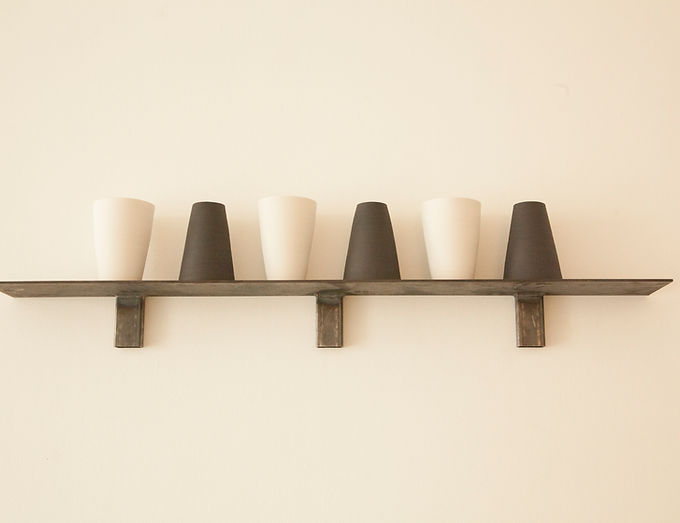
Absolutes
"Absolutes" explores the tension between opposing ends of the spectrum. The interplay of open and closed forms reinforces this contrast.

MATSU 末 : 'pine tree' or 'to leave behind' , 2017
An interactive piece inviting participants to write down something that hindered them from moving forward, offering an opportunity to let it go. Matsu is a personal interpretation of the Japanese O-mikuji tradition, found at Shinto and Buddhist shrines. In this practice, visitors receive random fortunes on strips of white paper by making a small offering. Regardless of whether the fortune is good or bad, the custom is to tie it to a pine tree—symbolically leaving it behind.

Video (Wedging : "kneeding/mixing" )
Creating 'Matsu' revealed underlying influences of Western culture that had shaped my internal beliefs—particularly the emphasis on independence, self, and ego. I had long held onto my identity through past experiences, often replaying old traumas in a continuous loop. During this period, I explored alternative philosophies and began to grasp the effort required to truly move forward.
This video reflects the weight of repetition and the tension that arises with the relentless labor of mixing black and white clay to find the perfect shade of grey.

Finding Grey - Ceramic (black and white clay), wood, steel
This piece features a pendulum of gradient-thrown ceramic objects, transitioning from white to black clay. The arching form mirrors the pendulum’s motion, symbolizing the constant oscillation between absolutes—light and dark, certainty and ambiguity, structure and fluidity. The raw dining table serves as both a physical and conceptual foundation, inviting conversation and reflection. It becomes a gathering space where ideas, perspectives, and emotions intersect, much like the pendulum swings between extremes, never settling, always in motion.

Interstice
Three ceramic slabs, each interrupted by a single, continuous crack—mirroring the fractures found in sidewalks. This break, cast and preserved, highlights the tension between human-made surfaces and the shifting, unpredictable earth beneath them. Though constructed for permanence, these surfaces inevitably yield to movement, time, and unseen forces. The piece explores the fragility of control, the inevitability of change, and the quiet dialogue between structure and nature, presence and absence, rupture and resilience.

Paper Chains, for Lao Lao (Grandmother)
A water bottle, a replica of the one in the story, sits beside neatly folded napkins—an echo of my grandmother’s habit, even at 94, of tucking scraps of paper into her sleeve. A quiet reflex, carried from a life spent holding onto what might one day be needed. As a refugee, she hid money, documents, even jewelry this way—small acts of survival that outlived the war, the journey, and even memory itself.
The story goes: When Lao Lao fled China for Taiwan, pirates raided the ship, taking everything. She begged them to let her keep a thermos of fresh water for her sick infant. They agreed. When they arrived at the docks, the authorities, seeing no documentation, threatened to send them back. In that moment, she slid open the sleeve of her thermos and pulled out papers proving they were Nationalist refugees. Only then were they allowed in.
This piece is a release—of inherited fear, of the quiet weight of survival, of the trauma passed down through generations. It is a gesture of remembrance and of letting go.